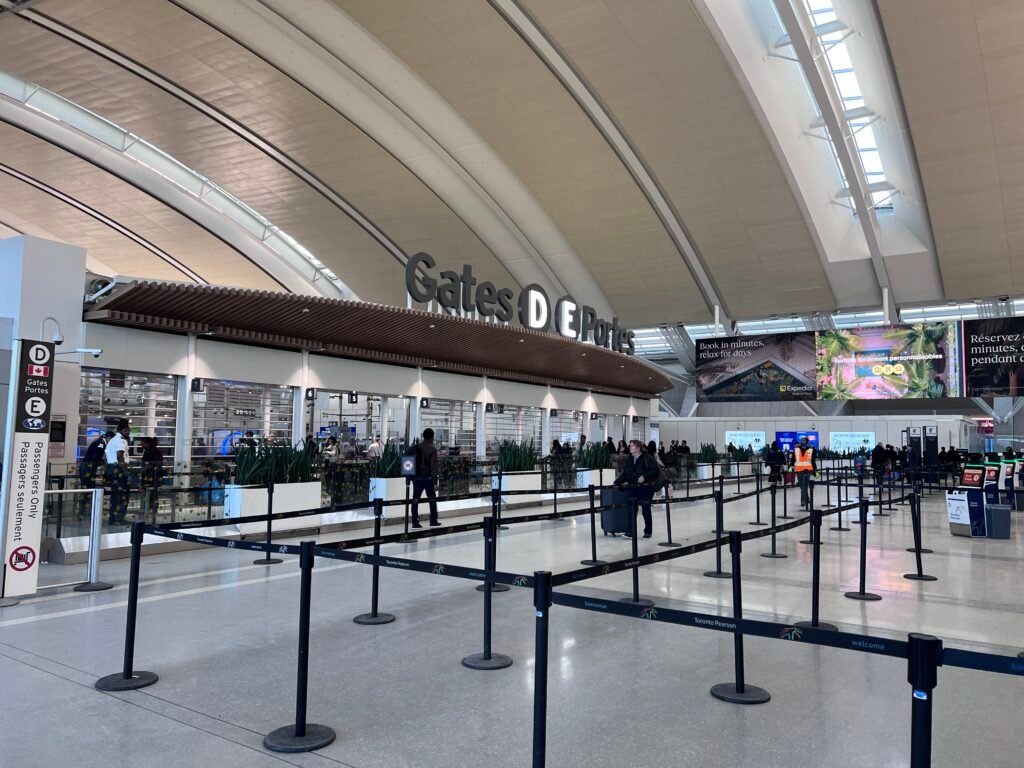
Tell me of a more exciting experience than reviewing your credit card statements right after the holidays 🙁 Interestingly, I realized most of the damage was not from spending at the Christmas markets, and it was not the gifts either (I mean, I’m not Santa Claus). It was the flights!
Somehow, all those domestic trips added up faster than everything else. Once I looked closer, the pattern was hard to ignore. Flying within Canada is shockingly expensive, sometimes even more expensive than flying internationally over a similar distance.
That raises a fair question: why can it cost less to fly from Toronto to Cancun than from Toronto to Calgary? The answer is a mix of geography, limited competition, airport fees, taxes, infrastructure bottlenecks, and the fact that Canada simply does not have many realistic alternatives to air travel on long routes. Let’s take a closer look at what is really behind those expensive domestic tickets.
Table of Contents
- Background
- Canada’s Geography and Prices
- Limited Competition Keeps Prices Higher
- The Struggle with Budget Airlines
- Taxes, Fees, and Surcharges Add a Lot to Your Ticket
- Airport Rent and High Operating Costs Matter Too
- Canada’s Infrastructure Limits Competition
- Few Real Alternatives to Flying
- Northern and Regional Routes Cost Even More
- Practical Ways to Save on Domestic Flights in Canada
Background
If you have ever priced out a domestic Canadian trip and then compared it with an international flight, you are not imagining things. Canada’s airline market has some structural disadvantages that make cheap domestic flying much harder to sustain. As a huge country with relatively low population density, a country with a highly concentrated airline market, one with high airport and regulatory charges, one with limited airport capacity on major routes, and one with weak competition from rail or other transport options, we have a lot working against us.
Canada’s Geography and Prices
Canada is the second-largest country in the world by land area, but its population is much smaller than other major aviation markets. That means airlines are trying to run long domestic routes across a very large country without the same passenger density available in places like Europe. This matters a lot because airlines rely on scale. In denser markets, planes can be filled more often, routes can run more frequently, and fixed costs can be spread over more travellers. In Canada, many major domestic flights are long-haul by default, and there are fewer passengers to distribute those costs across. So geography is part of the answer, but it is not the whole answer.
Limited Competition Keeps Prices Higher
A major reason domestic flights remain expensive is competition, or more accurately, the lack of it. The Competition Bureau’s 2025 airline study found that Canada’s domestic market is highly concentrated, with Air Canada and WestJet remaining the two dominant players. The same study also found that when just one new competitor enters a route, average airfares fall by about 9%. When only a few airlines dominate the market, there is simply less pressure to compete aggressively on price. Travellers may still get occasional sales, but structurally, the market does not behave like a highly competitive one.
The Struggle with Budget Airlines
A common reaction is why don’t more low-cost airlines fix this problem?
Sure, they have tried to. Several discount carriers have launched over the years, and several have failed or been folded back into larger brands. The challenge is that the Canadian market is difficult for ultra-low-cost carriers to survive in, and a major part of this is regulation. Canada still restricts cabotage, meaning foreign airlines cannot carry domestic point-to-point traffic within Canada. Transport Canada’s policy remains clear that cabotage rights are not part of Canada’s air policy approach.
There are also foreign ownership limits. Canada raised the foreign ownership ceiling for Canadian air carriers to 49%, but with important restrictions still in place, including a 25% cap for a single international investor and separate limits for foreign air carriers. Those rules are not the only problem, but they do make it harder for outside capital and outside operators to reshape the market quickly.
Taxes, Fees, and Surcharges Add a Lot to Your Ticket
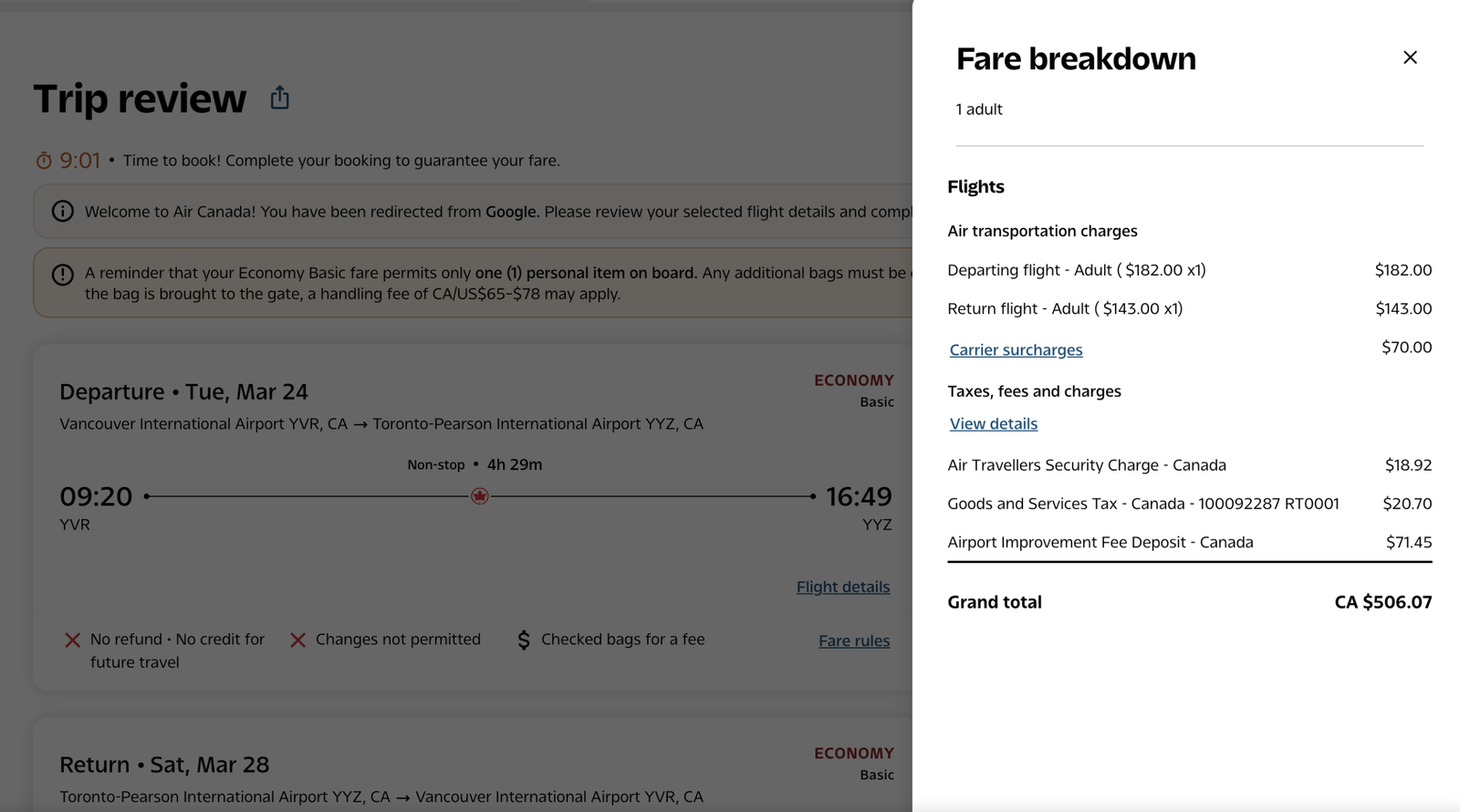
Another reason domestic tickets feel so painful is that the base fare is only part of what you pay. Canadian tickets often include multiple layers of charges such as airport improvement fees, the Air Travellers Security Charge, navigation-related costs, and sales tax. One important change in recent years was the increase in the Air Travellers Security Charge, which rose effective May 1, 2024. So even before baggage fees or seat selection enter the picture, Canadian domestic airfares are carrying a heavier fee burden than many travellers realize.
Airport Rent and High Operating Costs Matter Too
There is another cost built into the system that many passengers never think about: airport rent. Canada’s large airports operate on federally owned land, and pay rent to Ottawa. According to the Canadian Airports Council, Canada’s National Airports System airports paid $525 million in land lease rent in 2024. That money does not just disappear into the background. It ultimately affects airport finances and the fees charged throughout the system. Canadian airports also operate under a stronger user-pay model than airports in some other countries, which means more of the cost of infrastructure and operations is pushed back onto airlines and, eventually, passengers.
Canada’s Infrastructure Limits Competition
Even if more airlines wanted to compete, the infrastructure picture makes that harder too. Toronto Pearson handled 44.8 million passengers in 2023, then 46.8 million in 2024, and 47.3 million in 2025, showing how quickly demand has climbed. Busy airports near practical capacity create problems for competition with fewer attractive slots for new entrants, limited gate access, more bargaining power for established carriers, and less flexibility for airlines to add flights at desirable times.
In some U.S. metro areas, travellers can choose between multiple major airports. In Canada, that choice is much more limited. If you are flying from Toronto, Pearson YYZ is still the main game for most domestic routes. If you are flying from Vancouver, YVR dominates most major options. That lack of airport flexibility reinforces the market concentration problem.
Few Real Alternatives to Flying
In some countries, airlines must compete with fast and practical rail system. Canada does not really have that on most long-distance routes. Outside parts of the Toronto–Ottawa–Montreal corridor, passenger rail is generally too slow to serve as a true substitute for domestic air travel. Driving is often unrealistic on major interprovincial routes because of distance and time. When consumers have no good alternative, airlines face less pricing pressure.
Northern and Regional Routes Cost Even More
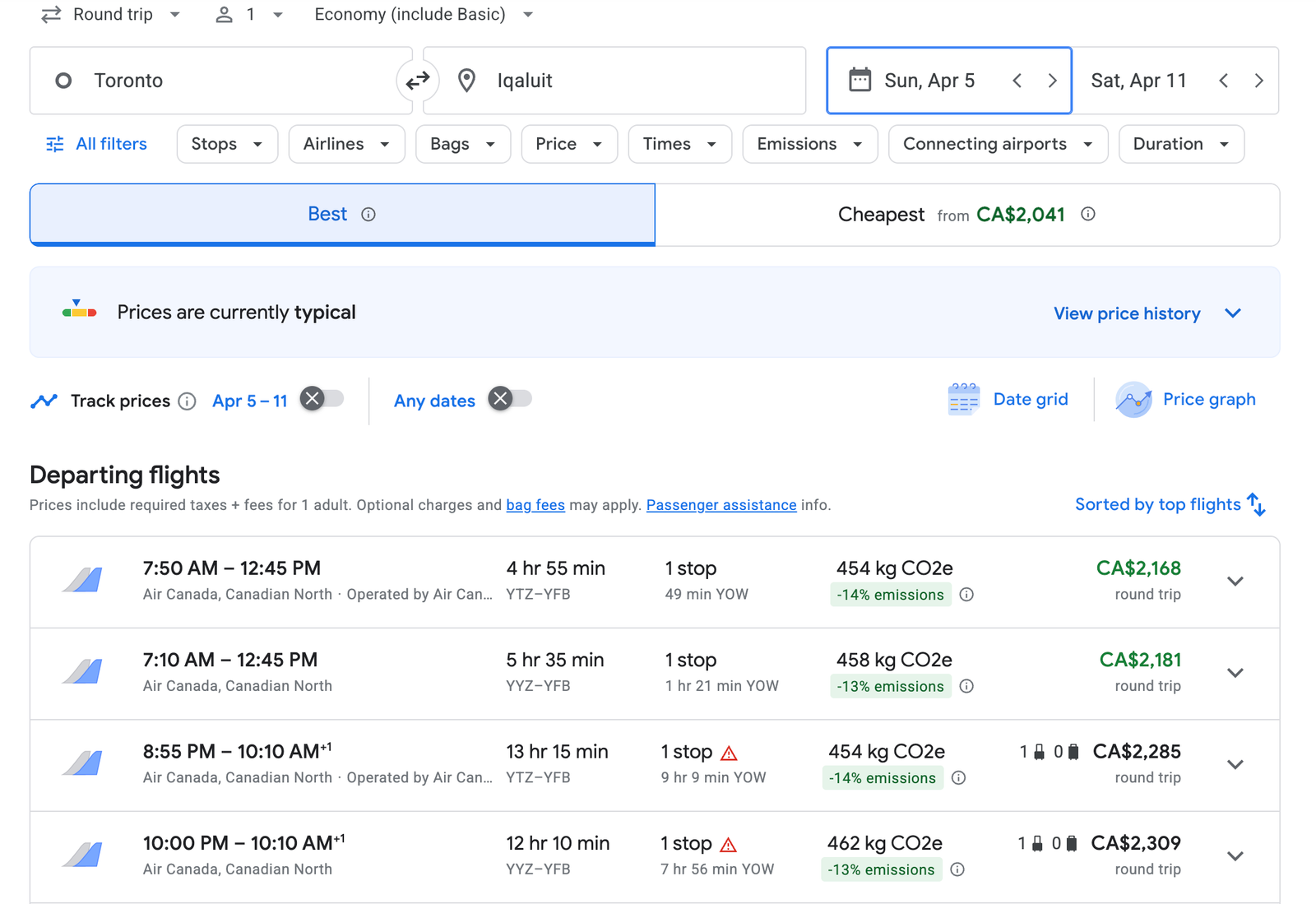
If domestic trunk routes feel expensive, northern and regional flights can feel extreme. That is because the economics get even tougher. These routes face fewer passengers, harsher operating conditions, weaker airport infrastructure, higher fuel and logistics costs, and little or no competition. For many northern communities, flying is not optional. It is essential. And because Canada does not have a U.S.-style nationwide Essential Air Service program on the same scale, affordability remains a major issue in remote air connectivity. The Competition Bureau’s report also notes that airline access is particularly important for remote and northern communities, where it acts as a lifeline rather than a discretionary convenience.
Practical Ways to Save on Domestic Flights in Canada
The structural issues are real, but there are still a few ways travelers can reduce the damage.
Strategy 1: The Border Hop
If you live near the US border, consider driving across and flying from a US airport. For example: Instead of flying Vancouver to Toronto for $650, drive to Seattle and fly Seattle to Toronto ($400 USD / ~$540 CAD). You save $110 CAD plus you avoid the higher Canadian fees. Some popular border airport options include:
- Buffalo, NY (for Toronto-area residents)
- Bellingham or Seattle, WA (for Vancouver-area residents)
- Plattsburgh, NY (for Montreal-area residents)
More importantly, be sure to factor in gas, parking, exchange rates, and your time. But for families or large groups, the savings can be substantial
Strategy 2: Strategic Use of Points and Miles
Using points and miles can be a great alternative to pay for your travels. Aeroplan, WestJet Rewards and even BMO Porter offer outsized value on domestic flight redemptions
Strategy 3: Positioning Flights Through the US
Sometimes it’s cheaper to fly Toronto to a US city, then, to Vancouver than direct. You add a connection, but save some money. Use Google Flights ‘explore’ feature to find these routing deals.
Strategy 4: Book Way Ahead
Booking very early, ideally 3 to 6 months in advance of your travel dates may be a good way to save some costs
Strategy 5: Be Flexible with Dates
Flying Tuesday-Saturday instead of Friday-Sunday can save 30 to 50%. Use Google Flights’ calendar view to see price differences across dates. Sometimes shifting by just one day saves $100 or more.
Strategy 6: Consider Alternative Airports
Secondary airports often have lower fees and less congestion. For example, flying from Hamilton (YHM) instead of Toronto Pearson for some routes, or from Abbotsford (YXX) instead of Vancouver for certain destinations.
Strategy 7: Track Error Fares and Flash Sales
Canadian airlines occasionally publish error fares or aggressive sales so significantly lower fares does happen, just rarely and briefly.
The Realistic Expectation
Now, while these strategies can save you 15 to 40% on many trips, they won’t make Canadian domestic flights as cheap as US or European travel. The structural factors we discussed — geography, oligopoly, fees — are still there. However, understanding the system means you can work within it more effectively.
Flights within Canada are expensive for reasons that stack on top of each other. It is not just that Canada is big. It is that Canada is big and lightly populated and highly concentrated in airline market power and expensive to operate in and reliant on a user-pay airport model and short on strong alternatives. That combination is what travelers are paying for.
Could this change? Yes, but only with policy shifts around competition, airport costs, infrastructure, and how Canada thinks about air travel as part of national transportation.