How Elora’s heritage, natural assets and proximity to Toronto created a boutique-hotel boom, and what that boom means for the people who live there.
Elora, Ontario, has a population of roughly 8,000 people. Yet, this small town has three luxury boutique hotels, before you even count the other bed-and-breakfasts. The price points of the hotel rooms are probably even higher than what you would find in Toronto. In June, the lowest room category at the Elora Mill Hotel was about $1,000 for one night, including taxes. A room at The Ayrshire Hotel was around $440, also including taxes, although breakfast was not included at either property. Which raises a fairly obvious question: Why does a town this small need this much luxury, and why would investors build luxury hotels here instead of Toronto or Vancouver? Perhaps more importantly, what actually happens to a small town and the people who live there when all of this luxury arrives?
Elora is not unique; Across Canada, boutique hotels are increasingly transforming small towns into destination travel experiences. Elora, however, offers a particularly interesting case study because several significant hotel investments are happening around the same time.
Elora Before the Hotels & What Made the Town a Viable Bet
These luxury hotels did not randomly appear in Elora; the town already had a lot going for it. In terms of location, it is roughly 90 minutes from Toronto—depending, of course, on the mood of the Gardiner Expressway. That distance does a lot for a town like this; it’s far enough from Toronto to feel like you’re getting out of the city, but it’s close enough that you can realistically drive there for a weekend. Then there’s the architecture. Elora’s downtown core is largely 19th-century limestone construction. Its walkable commercial core stretches roughly 25,000 to 40,000 square feet along the Grand River and is a major part of the town’s identity. Then there’s the obvious attraction- the Grand River. The river cuts a 22-metre gorge through the centre of the village. There’s the Tooth of Time limestone formation, river trails, swimming at the Elora quarry, and tubing at the Gorge, which had all been major attractions bringing visitors to Elora for many years, even before the hotels were here. The town was even named “Ontario’s most beautiful village”. The geography and heritage layer of the town were natural assets that were already working in its favour.
There was a catch, though. A lot of those visitors were only coming on day visits, primarily to see the gorge, walk around downtown, grab a coffee, maybe have lunch, and then go home. From an economic perspective, that meant money was still being left on the table. Elora had the tourism draw from daytime visitors, but what it didn’t have enough of was overnight spending. That’s exactly the kind of opportunity boutique hotel investors look for.
The Business Case and Why Investors See Opportunity in These Destinations
Elora is part of a broader shift in Canada, and in most parts of the world at large. There has been growing demand for experiential travel, particularly among higher-income travellers. Post-pandemic, travellers have increasingly placed more value on experiences, wellness and weekend escapes. Luxury boutique hotels are essentially the physical manifestation of that shift.
There’s also the yield argument and a strong case for attracting visitors who spend more. A destination doesn’t necessarily need millions of visitors to generate meaningful economic activity. Destination Canada’s strategy focuses on high-yield tourism, that is, visitors who spend more per trip rather than simply maximizing visitor volume. Centre Wellington’s own Economic Development & Tourism Strategy takes this a step further, explicitly using the phrase “quality over quantity”. The idea is to prioritize high-value, low-impact visitors in a way that increases community well-being while reducing pressure on infrastructure and resources. Boutique hotels are particularly designed around a visitor who may spend considerably more during a trip than a typical day-tripper.
The heritage layer is another reason these hotels work in small towns. Small towns often contain beautiful historic buildings that are extremely expensive to maintain. For an investor, that can become an opportunity. Once you turn a historic building into a luxury hotel, the thing that made the building expensive to maintain can become the thing that makes the hotel valuable. Elora has plenty of heritage buildings.
The proximity to a major city also adds another benefit. Elora is close enough to Toronto to tap into a large pool of relatively affluent urban customers, while being far enough away to feel like an escape. The town doesn’t have to compete directly with luxury hotels in downtown Toronto. Since it is offering a different experience to the same urban dwellers, the town can access urban spending without becoming an urban destination itself.
Role of Hotels in Creating Destination Gravity
A boutique hotel investment is often more than an investment in accommodation; it’s usually also a signal. It tells the market that someone looked at this place, ran the numbers and decided it was worth putting serious money into. That’s exactly what has happened in Elora with the Pearle Hospitality Group making a major investment in the destination by renovating the Elora Mill. Then The Ayrshire arrived, this time with residents investing in their own town, and later, Kat Florence followed. It’s how investment confidence can compound in a small market. One credible investor changes the signal; another investor thinks, maybe there’s something here. Then another.
Evidence 1- The Elora Mill
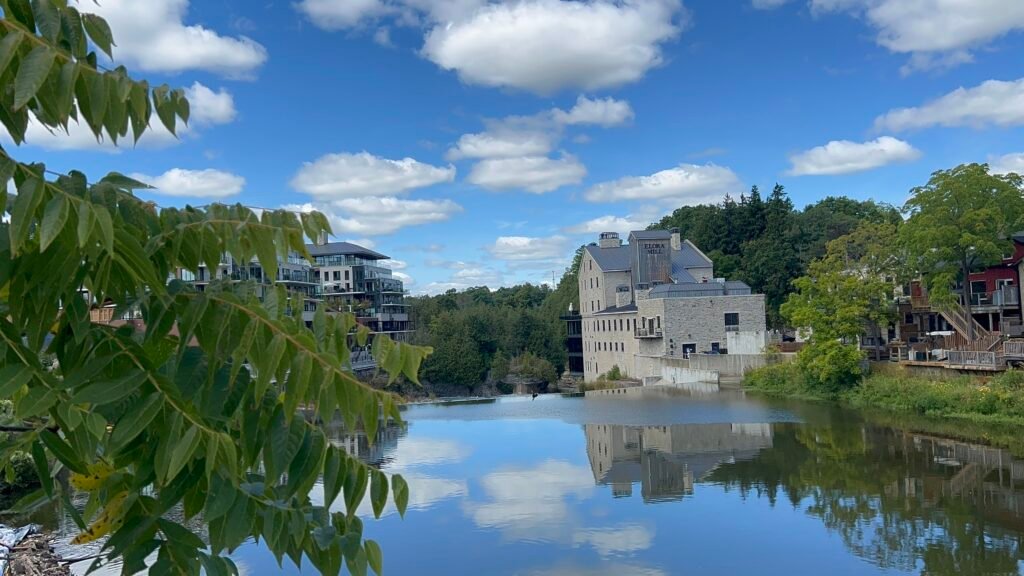
The Elora Mill has been part of the town’s story since the 19th century when William Gilkison, a Scottish naval captain, bought half of Nichol Township in 1833. The mill on the current site was eventually built in 1843 by Charles Allan’s company. It was sold to J.M. Fraser in 1846, burned in 1859 and was rebuilt in stone that same year. Over nearly two centuries, the building repeatedly changed purpose- as a gristmill, a sawmill, a flour mill, a distillery, a hotel in the 1970s, and eventually it closed and went bankrupt in 2010. Pearle Hospitality Group acquired and renovated the property, reopening it on July 6, 2018, as a 30-room luxury hotel and spa with many of the rooms overlooking the gorge. The rooms were designed in three different styles—rustic, modern and French— incorporating the original limestone walls and exposed wooden beams. There’s also a spa with a heated pool, hot tub, steam room and sauna. The hotel has a restaurant on two levels, both overlooking the gorge, and there are event spaces for weddings and corporate retreats. Opening rates in 2018 started at approximately $450 per night; the hotel was a bet on Elora as a food and cultural destination.
Evidence 2- The Ayrshire Hotel
Just a few steps away from the Elora Mill is The Ayrshire Hotel, representing a very different type of investment. The owners, Teal and Eric Parkinson, are Elora locals and don’t have a typical hotel development background. One is a former archaeologist and Canadian Studies professor, while the other is a fire captain. These are people who believed in their town enough to put their own money behind it. Their first property was Ayrshire House at 249 Geddes Street, a six-room guesthouse which they ran for five years. It worked well enough that they decided to make a much bigger bet; this time, they bought the Dalby Building. The Dalby Building was originally constructed in 1865 and is one of Elora’s most historically significant structures. Over the years, it housed doctors’ offices, stagecoach operations, a watering hole and a public court. It is also Canada’s oldest flatiron building. The Parkinsons transformed it into a nine-room boutique hotel, which opened in 2025 with a Lobby Bar on the ground floor. The hotel’s name is connected to Elora’s history. William Gilkison, the founder of Elora, came from Ayrshire in Scotland; Eric Parkinson’s grandmother also came from Ayrshire.
Then there’s the Kat Florence Hotel. Another luxury boutique hotel, this time in a restored 1840s stone building. Within its first month of opening, it was reportedly booked solid through the following winter.
At this point, Elora has a luxury hotel cluster, but that doesn’t mean it has enough accommodation overall. One of the interesting contradictions in Elora’s hotel boom is that the town simultaneously has several luxury hotels and still has an accommodation shortage. Centre Wellington’s Economic Development & Tourism Strategy identifies a shortage of diverse accommodation as a barrier to attracting longer-staying visitors. There are four primary accommodation options across a broad rate spectrum; however, the strategy specifically identifies a shortage of mid-range hotels and motels, perpetuating a demand for short-term rentals.
The Local Impact- What Three Hotels Changed
The most significant change to Elora with the rise of boutique hotels is the visitor profile. Overnight visitors spend roughly three to four times more per visit, spending not only at the hotels but also at restaurants, galleries, stores, the distillery and other local businesses. So while the visitor arrives because of the hotel, their spending spreads throughout the community.
The impact on the town’s tourism seasonality is another major benefit. If visitors disappear for half the year while it’s cold, businesses have a difficult time sustaining themselves. Centre Wellington’s strategy describes Elora’s historical winter gap as severe enough that local establishments operated with skeleton teams just to survive until the next season. The hotels provided another reason for visitors to stay in the town during the off-season
One of the strongest arguments for boutique hotel development is heritage preservation. Elora’s limestone buildings are a huge part of what makes the town attractive, but they’re expensive to maintain. Boutique hotels have a direct financial incentive to preserve them because the building itself is part of the experience being sold. A historic structure that might otherwise be difficult to maintain can become economically valuable precisely because of its history.
The positive impact is also felt through employment opportunities and the multiplier effect. Luxury hospitality can create higher-skill, higher-wage positions than budget accommodation. There is a caveat to this, however, as hospitality jobs can also be seasonal and part-time, so the employment story isn’t completely straightforward. The broader multiplier benefit is evident across restaurants, galleries, retailers and local suppliers.
Tourism success unfortunately comes at a cost in some cases. The small town of Elora attracts around 750,000 visitors a year, and residents have been clear that while the economic benefits are real, so are the pressures on infrastructure and quality of life. There’s an obvious wealth transfer with more money flowing into the community when tourists increasingly visit, but at what point does the balance tip?
Short-term rentals are one part of the problem, creating housing pressures for the town. Residents say they’re pushing long-term renters out of the housing stock. Rising property values have a very different effect depending on who you are. If you’re a homeowner, rising values may be good news; if you’re a renter, a young family or someone whose income isn’t increasing alongside property values, the situation looks very different. Centre Wellington’s strategy backs up these concerns, identifying short-term rentals as contributing to housing-access challenges for both residents and seasonal workers, alongside concerns about visitor behaviour.
For a small town with a large tourist population, parking and congestion are often unavoidable. Some locals have mentioned that they avoid downtown because of traffic and congestion. The township’s strategy confirms concerns around parking, long restaurant lines, wait times and large crowds in public spaces. It also notes that the large visitor presence can reduce residents’ interest in visiting their own downtown. The strategy now has a formal recommendation to develop creative visitor-management tactics to curb overtourism in Centre Wellington’s urban centres.
There is also the question of affordability. Can residents afford the hotels that increasingly define their own town? The luxury boutique model is aimed at a particular income bracket, and many residents will never spend a night in the buildings that now help define Elora’s image. Which brings us to a much bigger question about destination development- who gets to define a town? When a town’s character becomes its product, who gets to shape what that character is? Elora has the limestone buildings, the boutique stores, the dining, the gorge, the quarry, and the experiences, but there’s a difference between curating a place for visitors and creating a place that works for the people who live there. When luxury boutique hotels succeed in a small town, the town can become better for visitors, and more expensive for residents. In a village of 8,000 people, the line between thriving and being priced out of your own community can become pretty thin.
The Bigger Trend- Is Elora an Outlier?
The conditions that made Elora attractive to investors—heritage buildings, natural assets and proximity to urban wealth—exist in several Canadian small towns, but Elora is a concrete example of how investment confidence builds in a small market after one credible player changes the signal, and others follow.
There’s another reason Elora’s hotel boom has another interesting angle to it. The town has been adapting its economy around its physical assets for nearly two centuries. William Gilkison’s mill and the area’s water power were once central to Elora’s economic development. Over the years, the mill changed uses repeatedly as the economy changed, and eventually, the industrial role of the site diminished. The gorge and the river remained, and the same physical landscape that once provided economic value through water power increasingly became valuable because of its scenery. Boutique hotels are now monetizing that sense of place in another way. The economy has moved from using the river to selling the experience of being beside it.
Looking Ahead
Looking ahead, Centre Wellington has a 20-year vision to become a complete, four-season destination. One of its guiding principles is that tourism should contribute to, not compete with, community well-being. This may be increasingly difficult to balance as the destination grows. Boutique hotels are now bets on a destination, and when those bets work, they can change how a small town markets itself, how visitors spend money and sometimes how communities evolve. For visitors, that can mean memorable experiences; for local businesses, it can mean customers throughout more of the year. While hotels can preserve historic buildings, create jobs and attract additional investors, they can also put pressure on housing, increase congestion and change the identity of a place. Ultimately, that raises some difficult questions about affordability, identity and who these towns are being built for. Elora may be one of Canada’s best examples of this transformation, but it’s unlikely to be the last.
Elora raises a bigger question about the boutique hotel boom happening across Canada- are luxury boutique hotels simply responding to popular destinations, or are they helping create them? Elora had the natural assets, heritage and proximity to Toronto that made it attractive in the first place. But once investors started putting serious capital behind those assets, the destination began to look different.