How Much Money Does The CNE Make?
The Canadian National Exhibition (CNE) is an 18-day fair and temporary marketplace that must generate enough revenue to finance itself for a full year. How does a 146-year-old fair remain financially sustainable when it has 18 days to make the money, navigating high fixed costs, seasonal revenue, weather risk, attendance risk, and safety risk?
Origin and Goal of the CNE
The CNE dates back almost 150 years. In 1879, it was established as the Toronto Industrial Exhibition, a trade show for machinery and livestock designed to promote agriculture and technology in Toronto and the surrounding area. Agriculturists, engineers, and scientists would come to exhibit their discoveries and inventions, and the fair was originally about showcasing advancements in agriculture and industry. In 1912, it was renamed the Canadian National Exhibition. That year, attendance was approximately 962,000, with around $385,000 in revenue. Since then, the event has expanded to include a carnival, live music, parades, an air show, various entertainment, and food.
How Does the CNE Make Money?
While it’s a carnival for people to have fun, it’s also a business that makes lots of money. This is one very profitable business. Think of the CNE as having multiple layers of monetization- from admission tickets to the midway, food, vendors and exhibitors, sponsorships, premium experiences, and other activities – there are several ways the organization generates revenue. On closer look, the CNE’s main product is concentrated attention. There are very few places in Toronto, or even Canada, where you will find over a million people coming to one place over 18 days. Access to all these people is why vendors are willing to pay to be here, why brands sponsor the event, and why those very weird foods matter.
1. Admission Tickets / Tickets Revenue
To start, you need a ticket to get into the grounds where all the fun is happening, so access to the entire ecosystem is the first revenue funnel for the CNE. For 2026, regular adult admission was $26.55 before HST. That single entry ticket buys access to concerts, exhibits, shows, the farm, performances, shopping, food areas, gaming, attractions, and everything else at the fair. The CNE deliberately makes the base ticket relatively broad, then monetizes visitors once they’re inside. Its whole point is to get you inside first, and then keep you there. The CNE’s 2025 Food & Retail Prospectus says its research found that average individual visitor spending was $174. It also identifies food, shopping, and rides among the major reasons people attend.
But even with this entry fee, the CNE has several forms of price discrimination. In other words, it recognizes that different people have different willingness and ability to pay. For 2026, general admission was $26.55, while admission for seniors and children was $22.12. A family pass cost $84.07 and was valid for either two adults and two children or one adult and three children. There was also a Ride All Day entry ticket for $75.22, a Drag Brunch experience for $102.99, $13 evening tickets on selected dates, and $2 children’s admission on Mondays. Children four and under could enter free with a paying adult. By offering different ticket options, the CNE is able to maximize participation while allowing the organization to generate more revenue from visitors who are willing to pay more.
2. The Midway (Rides and Games)
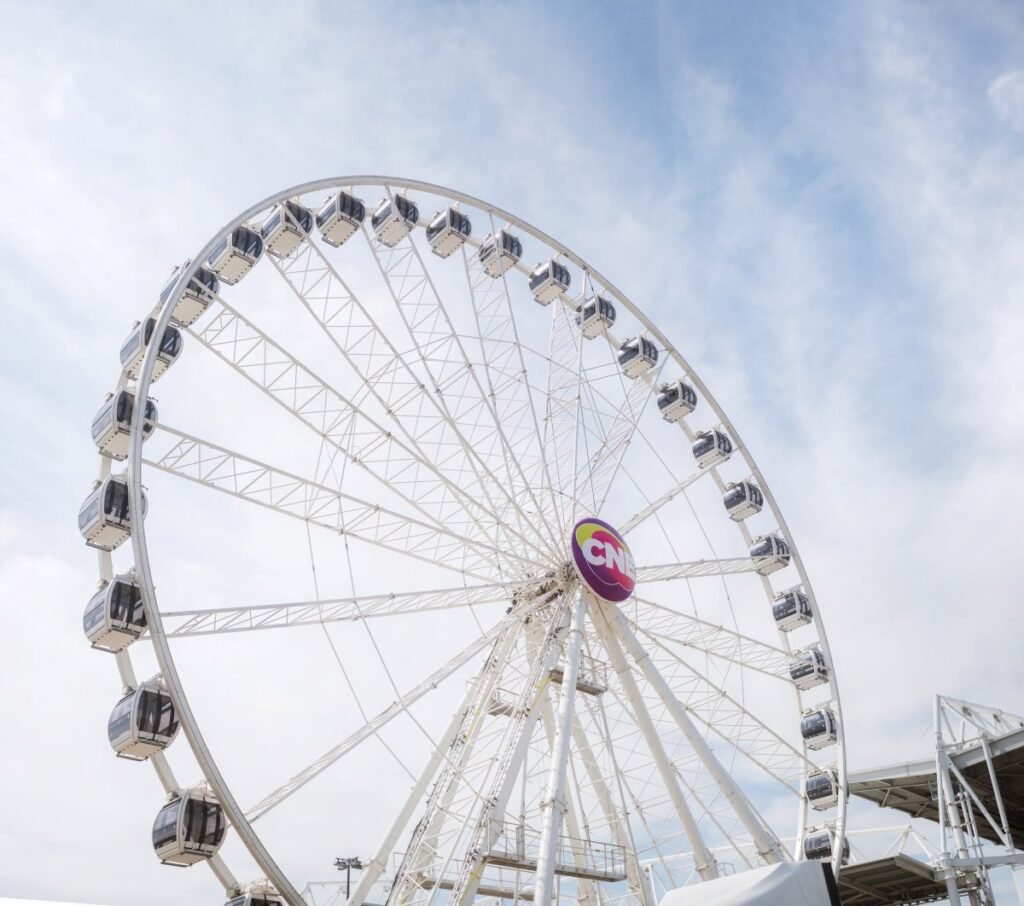
The midway is essentially a business within the business; interestingly, the CNE does not own or operate the rides. North American Midway Entertainment operates the midway, and the CNE has historically received commissions from its operations. As far back as 2007, the CNE received a financial return estimated at $2.1 million annually from North American Midway Entertainment to operate the midway at “The Ex.” There are also other vendors in the midway that the CNE makes money from. According to the CNE’s concession and midway guidelines, operators generally pay 25% of their gross sales, minus taxes, or a predetermined minimum rate guarantee, depending on which amount is higher. So, rather than having to own and operate every ride and game itself, the CNE can generate revenue from the businesses operating them.
3. Food
Deep-fried cheese curds. Deep-fried Oreos. Deep-fried mozzarella. These are only some of the many deep-fried foods you can find at the CNE. At this rate, Canada’s healthcare will need to remain free as long as the CNE exists! All these novelty foods are actually a form of customer acquisition. The food at the CNE is one of the reasons people keep coming back year after year, and it has almost become a competition to see how weird the food can get. The good part is, it’s free marketing! The novelty of the food generates so much social media attention on TikTok and Instagram, news coverage, and YouTube videos, and that attention increases attendance because people want to see and taste the food themselves. More attendance can mean more spending, ultimately increasing both vendor revenue and revenue for the CNE, because the CNE gets a commission on every single sale. The CNE’s published outdoor concession agreement states that the organization receives 25% of net sales, subject to a minimum-rent calculation. That’s exactly why the CNE is obsessed with food novelty, as, to a large extent, it is a way to attract more visitors.
4. Shopping (Temporary Retail Marketplace)
The CNE essentially turns Exhibition Place into a temporary retail marketplace. Retail exhibitors pay the CNE for exhibit and booth space during the fair. In exchange, they get access to a very large, concentrated audience. For a small business or brand, this means putting its products directly in front of thousands of potential customers every day, rather than having to attract those customers individually. For the CNE, it means monetizing the audience it already has even further. For visitors, shopping gives them another reason to browse, linger, and spend even more money while they’re on the grounds. The economic logic is simple: the CNE has something businesses and exhibitors want – a massive audience concentrated in one place for 18 days.
5. Free Programming
The fair offers a lot of free activities included with an admission ticket: concerts, shows, exhibits, attractions, and more. One of the days I went, I caught a wrestling match. On a high level, it seems quite generous, but when you zoom in, you’ll see that the main goal is to make you stay longer. While these events do not necessarily generate revenue directly, they complement the other revenue mechanisms. The more time you spend at the CNE, the higher the chance that you’ll want to play a game, eat some food, or do some shopping. The CNE is effectively using entertainment as an acquisition tool. Your admission ticket buys access to many different experiences, increasing the perceived value of the ticket, encouraging you to visit, and giving you a reason to stay even longer.
Concerts
At this year’s event, there were around seven stages with numerous concerts and performances, with no additional cost to attendees beyond their admission ticket. The CNE could charge for the concerts, and I’m sure people would pay for them, but it would rather keep them free, drive attendance, and use them as a mechanism to keep people on the grounds, where it can monetize food, rides, shopping, and concessions.
VIP Concert Experiences
Even within its free programming, the CNE has found a way to monetize those willing to pay more. At the concerts, there are VIP sections where you pay extra if you want to be a little more comfortable.
The Farm
Then there’s the Farm, which preserves the CNE’s original agricultural identity. It connects today’s CNE to its origins as the Toronto Industrial Exhibition, where agriculture and industry were central to the fair. Even today, the CNE is still largely identified as an agricultural society. The Farm helps the CNE maintain the heritage and institutional identity that separates it from a conventional amusement park while also creating another reason for families to spend more time on the grounds, increasing opportunities for spending elsewhere.
The Air Show
The Air Show is the CNE’s biggest spectacle and one of its biggest attendance drivers. It creates a huge Labour Day weekend attendance spike and gives people a compelling reason to visit the CNE specifically at the end of the 18-day run. It also generates enormous media attention and visibility for the CNE. You don’t actually have to buy a CNE ticket to watch it; you can just watch from Lake Shore Boulevard and the surrounding areas, but the Air Show is a massive marketing event for the CNE. While the Air Show itself doesn’t sell tickets, it makes the entire CNE feel like the place to be on Labour Day weekend.
6. Premium/Enhanced Experiences
The CNE doesn’t have to charge everyone more to increase revenue. Instead, it has created premium experiences for people who are willing to pay more. The Drag Brunch is a good example. It’s an additional paid experience layered on top of general admission, so it is a form of upselling. Visitors can buy the basic CNE experience or pay extra for something more exclusive, allowing the CNE to capture more spending from its highest-value customers without raising the admission price for everyone.
7. Sponsorship
The CNE isn’t only monetizing its visitors; it’s also monetizing their attention. A company looking to advertise would pay for access to a concentrated audience. More than a million people coming through the gates is an enormous marketing opportunity for brands, so the CNE gets to sell access to all these people to other businesses. Sponsors can pay for things like brand activations, product sampling, consumer engagement, and visibility. Sponsorship revenue is particularly valuable because it comes from a completely different customer- the brand rather than the visitor. Because sponsorship sits alongside admission, food, rides, and shopping, the CNE can generate revenue from the same audience multiple times.
8. Parking
This is one revenue source I did not figure out until much later, and it must have been a good revenue source. I’m not sure exactly what category to put this under, but I found out that parking in the lot just outside the Princes’ Gates during the fair was a $50 flat fee. There were also parking spaces available on the grounds where the fair was happening. I’m sure the CNE makes a considerable amount from parking fees during those three weeks every year!
Canadian National Exhibition Association (CNEA) as a Not-for-Profit Make Organization
The CNEA is officially a not-for-profit agricultural society without share capital, but that doesn’t mean its revenue has to be exactly equal to its expenses; it’s allowed to make a profit. The difference is that its shareholders aren’t receiving dividends, and owners aren’t taking the surplus profit. Instead, the surplus stays within the organization and can be used to support its future activities. So, while the CNEA isn’t designed to maximize profit for owners, it generates enough revenue to cover its costs, build financial resilience, and reinvest in the next fair. But being financially independent comes with its own risks. Before 2013, the CNEA wasn’t financially independent in the way it is today. From 1983 to 2013, the CNEA was both an agricultural society and a program of Exhibition Place. During that period, CNEA surpluses and deficits were absorbed by Exhibition Place and the City of Toronto.
In 2013, the CNE Association became financially independent of Exhibition Place and the City of Toronto. That independence meant it could keep what it earned, but it also meant it now owned all the downsides and risks that came with it; plus, it pays rent to the City to use Exhibition Place, which the City of Toronto owns. Seven years after the Association became independent, it got its first major test. When the 2020 fair was cancelled due to COVID, the CNEA reported a loss of over $6 million and estimated a 95% drop in projected revenue. That meant more than $35 million in potential earnings from ticket sales, exhibitor commitments, sponsorships, and other income was at risk. It was expected that the organization would run out of cash by December 2021 without around $11 million in government support. It took a $7 million non-repayable federal investment through the Government of Canada’s Major Festivals and Events Support Initiative to bring the fair back in 2022. So, there’s an upside to its independence, but there are downsides as well.
Economic Impact of the CNE- Is the CNE Worth It to Toronto?
A $7 million non-repayable investment is A LOT OF MONEY. Why would the government give this much money just to sustain a fair?
Apart from that investment, the CNE operates every year on publicly owned land at Exhibition Place. While it pays rent, it actually gets a very sizeable discount. So, quite reasonably, one may wonder why Toronto continues to support an 18-day fair. How important is the CNE to Toronto and to Canada?
Revenue for the City
In 2025, an economic impact assessment estimated that the CNE generated approximately $129 million in economic impact for the Greater Toronto Area and over $164 million for Ontario. But that’s not money going directly into the CNE’s bank account. Economic impact is about the spending the event generates throughout the wider economy — visitors, workers, vendors, exhibitors, suppliers, restaurants, hotels, transportation, and other businesses. The CNE brings more than 1.4 million people into one location over just 18 days, and those people don’t exist in an economic vacuum; they’re buying food, shopping, travelling, working, staying in hotels, and spending money around the city.
Employment
The CNE hires approximately 1,200 people beginning in the spring to plan and produce the fair. During the fair itself, another 5,000 people are employed by CNE partners, including food vendors, exhibitors, emergency services, Toronto Police, and Toronto Fire. That’s thousands of people whose work is tied, directly or indirectly, to putting on an 18-day event.
Marketplace for Businesses
More than 700 exhibitors participate in the CNE. For those businesses, the fair provides something difficult to replicate- access to more than a million consumers concentrated in one place. The same is true for sponsors, food vendors, and other commercial partners. So, the CNE isn’t just generating money through its own admission tickets and concessions; it’s also creating an economic platform that other businesses can use to make money.
Toronto may enjoy having a fair every year, but that same fair concentrates people, businesses, workers, and spending in one place, then distributes that economic activity throughout the surrounding economy. That’s really the economics of events. The event itself is only one part of the business.
Canada’s Fair Economy
The CNE is part of a much larger Canadian fair and exhibition economy. According to the Canadian Association of Fairs and Exhibitions, Canada has approximately 743 fair and exhibition organizations hosting more than 17,000 events and activities and attracting more than 35 million visitors every year. Fairs are actually very important to the Canadian economy, not just because they keep Canadians happy, but also because they bring lots and lots of money into the country. The industry estimates its economic impact on local communities at approximately $2.9 billion.
CNE’s Location at Exhibition Place
Exhibition Place is a 192-acre site where the carnival takes place, owned by the City of Toronto and managed by a Board of Governors. The CNE pays the City every year to use Exhibition Place, occupying the entire site essentially during the fair. The market-rate equivalent is substantially higher, but the CNE gets a “friends-and-family” discount. In 2026, it paid $4.29 million in licence fees after discounts. The location has been associated with the exhibition since the late 19th century. In 1878, the City leased the western part of the former military reserve, creating the Exhibition Grounds. The following year, the Toronto Industrial Exhibition opened there. The scale of the land is very important because it allows the CNE to operate the midway, food, livestock, exhibitions, concerts, shopping, sports, and indoor programming all at once. It also has great transit access, with Exhibition Station right beside the grounds, while TTC streetcars and buses serve the site. And it’s right beside Lake Shore Boulevard West and the Gardiner Expressway for those commuting by car.
But that’s about to change. In good news, or maybe bad news (depending on your stake and interest in Exhibition Place), the City of Toronto now has a new vision plan for the site that has been approved by the Board of Governors. The plan is to turn this very popular summer spot into a year-round destination dedicated to major events and festivals. It’s supposed to have a new front entrance, a Nexus Park that will include another food building, and a festival plaza. If this happens, it’s still undecided what would become of the CNE and whether it would need to find another location. But really, where else in Toronto would be a good alternative for a fair this big?
CNE’s Real Business
The CNE, while in itself a giant carnival, is economically more like a marketplace bringing together millions of consumers, hundreds of vendors, sponsors, performers, ride operators, food businesses, and retailers in one central location. The CNE’s real product is not so much the rides, the food, or the concerts, but more the audience it is able to bring together for 18 days. This creates the conditions in which everyone else – vendors, sponsors, exhibitors – wants to participate.
References:
https://www.blogto.com/city/2020/09/cne-close-permanently-deficit-pandemic
https://www.toronto.ca/legdocs/mmis/2007/ex/bgrd/backgroundfile-8823.pdf
https://www.theex.com/wp-content/uploads/2026/02/2026-Application-Guidebook-Final.pdf
https://www.theex.com/wp-content/uploads/2024/09/2024-CNE-Final-Attendance_FINAL.pdf