Maple syrup is nature’s sweetest and most underrated economic gift to the world, mostly to Canada. A barrel of maple syrup is worth more than fifteen times the price of a barrel of crude oil! Most people buying it at the grocery store have absolutely no idea how it’s made, who sets the price, or just how tightly the whole operation is managed. Canada doesn’t just produce maple syrup, we control the global supply through a system that economists have compared to OPEC (Organization of Petroleum Exporting Countries), with a strategic reserve holding enough syrup to supply the world for nearly an entire year.
What looks like a simple breakfast condiment is, underneath the surface, one of the most carefully managed agricultural commodities.
Maple Sap Harvesting Season
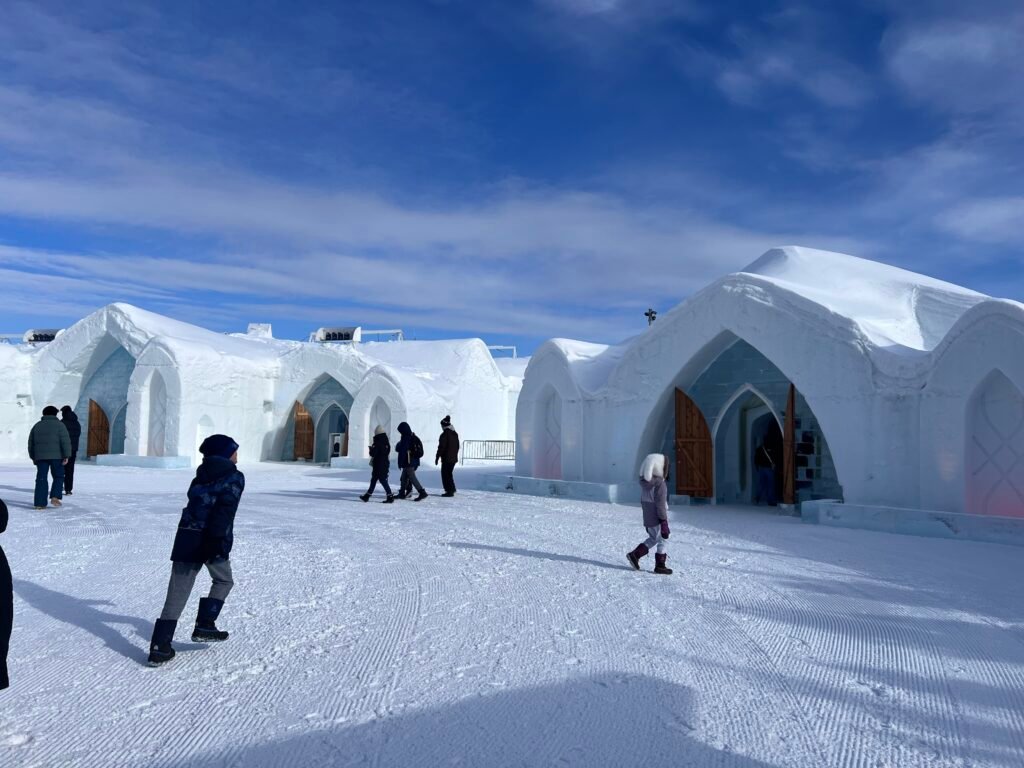
Every spring, communities across Quebec and Ontario mark the end of winter with sugaring-off festivals. This year, I visited Elliott Tree Farm Maple Syrup Experience and the Spring Tonic Maple Syrup Festival, both in Ontario.
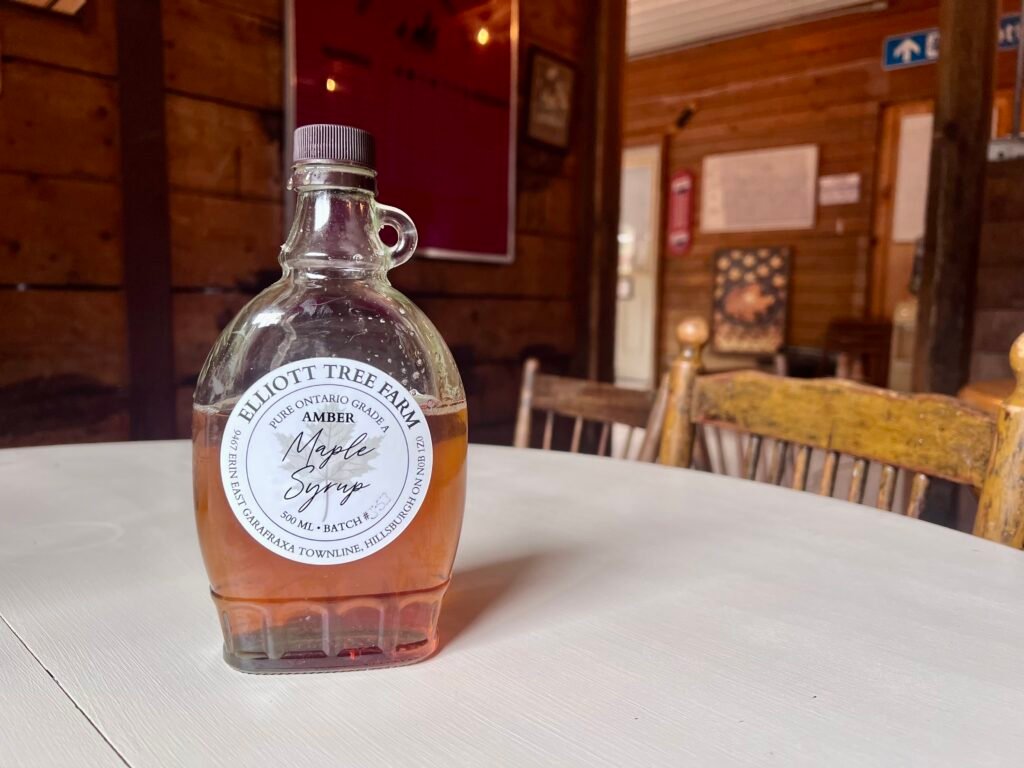
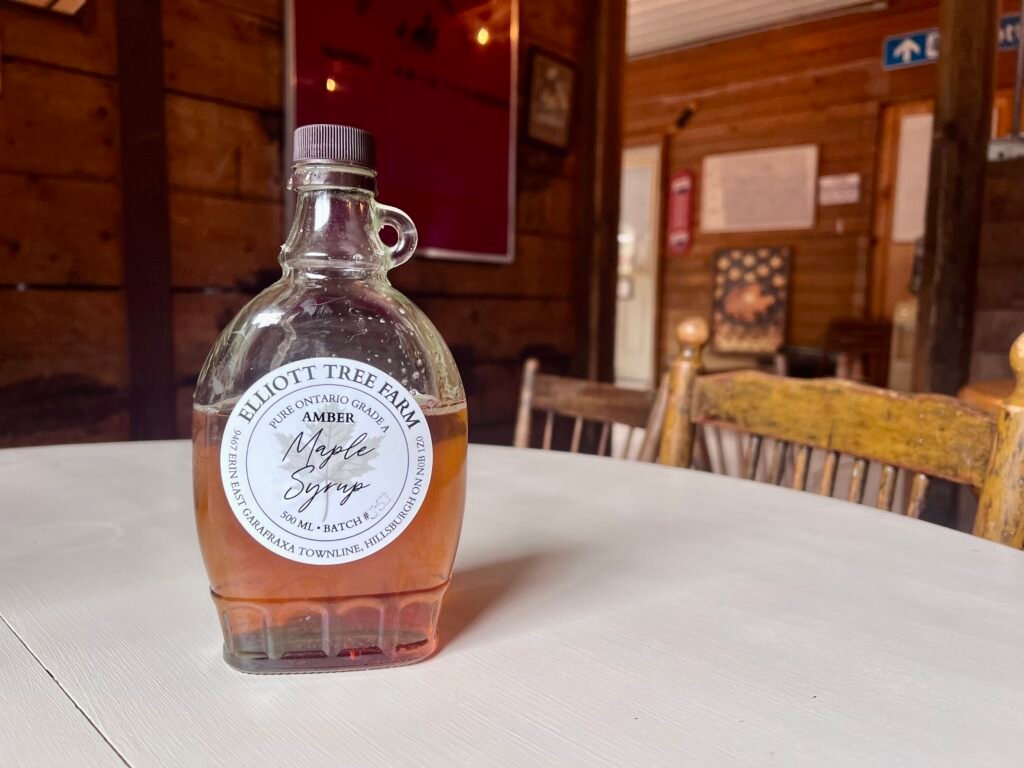
At first, it feels like exactly what you’d expect- maple taffy, maple butter, maple candy, maple everything. However, past all of that, there’s a real industry operating underneath. At Elliott Tree Farm, a 500ml bottle of maple syrup was selling for $28 !
To understand more about this industry, let’s go back to the very beginning, starting with the tree itself (where the syrup comes from), and with the indigenous people who figured out this sweet treat
The Sugar Maple Tree
The sugar maple is probably the crown jewel of Canadian trees. In summer, it produces food through photosynthesis (like every other tree), but in autumn, that excess energy moves down through the sapwood into the roots, where it spends the entire winter stored as starch, frozen underground. Then, when temperatures begin to shift in late winter with nights still below freezing and days creeping above zero, that starch converts to sugar and rises back up through the tree. That liquid is the sap.
The Wabanaki, the Mi’kmaq, and other Indigenous nations were the first to understand this cycle. They had been harvesting maple sap and converting it to maple sugar long before European settlers arrived, drilling holes into trees with wooden spouts, collecting the sap in bark containers, and boiling it down with heated stones. When European settlers arrived in the early 1600s – many of whom did not survive their first or second Canadian winter – they adopted and scaled this practice. The result, over the following centuries, became the global industry it is today.
The reason Canadian maple syrup dominates the world comes down to geography that cannot be replicated. Sugar maple trees grow only in a very specific band of northeastern North America; from Ontario east to Nova Scotia, and down into the northeastern United States as far south as Ohio. Many people have tried to transplant these trees elsewhere, but they just won’t grow. They need harsh winters, specific elevation, and specific soil composition. That constraint is both the industry’s greatest vulnerability and its greatest competitive advantage.
Sap to Syrup
Maple trees need to be at least 30 to 40 years old before they’re tapped, and a healthy, well-maintained sugar maple can produce sap every single year for over a century without harm. To get the sap, a spile (a small tap) is drilled into the sapwood of the maple tree, and the sap begins to flow, one drop at a time. Traditional operations used hanging buckets collected by hand; modern commercial operations now run networks of plastic tubing that carry sap directly to collection tanks.
Raw sap looks almost exactly like water. It’s slightly sweet, containing about two to three percent sugar by volume. What you eventually pour on your pancakes is the product of boiling out 97 percent of that water. On average, it takes about forty liters of raw sap to produce just one litre of maple syrup; a long, sustained boiling process that runs for hours, sometimes an entire day. The finished syrup is drawn off when it reaches four and a half degrees Celsius above the boiling point of water and is graded by colour: golden with a delicate taste comes from early-season sap when sugar content is highest; amber with a rich taste arrives mid-season; dark with a robust taste comes as temperatures rise toward season’s end.
By Canadian law, maple syrup must be 100 percent pure maple sap at a density of 66 degrees Brix, with no additives, no corn syrup, and no artificial flavouring. What is in the bottle is exactly what came out of the tree.
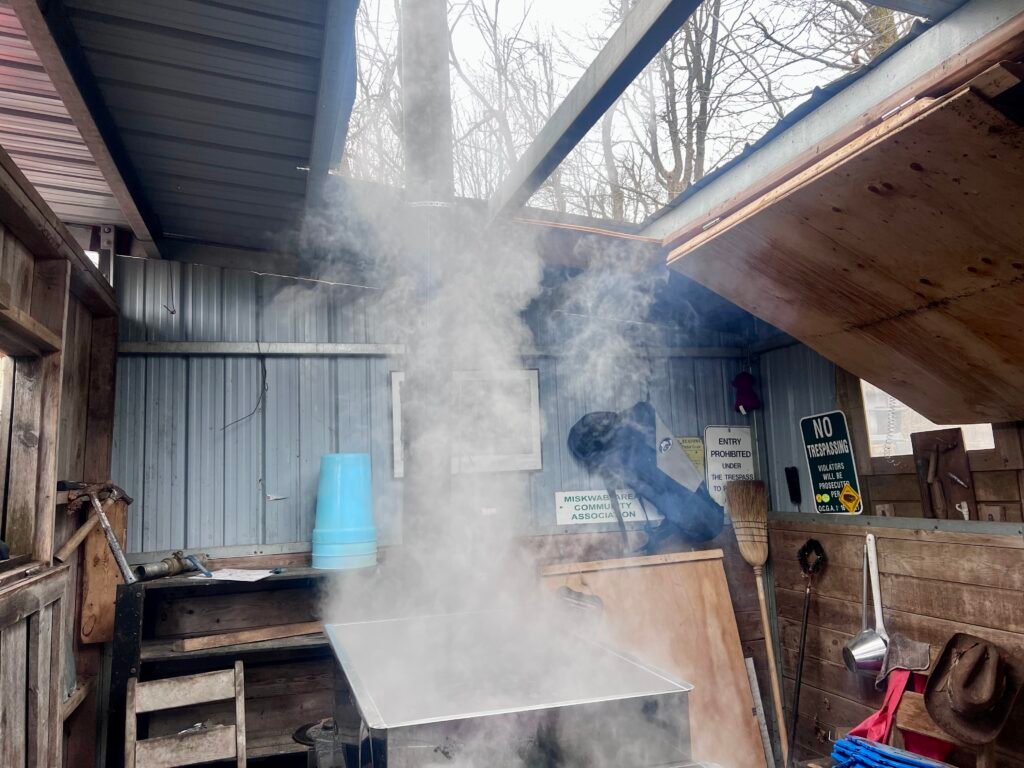
Sugar shack where sap is boiled
The Federation: The OPEC of Maple Syrup
In 1966, Quebec maple syrup producers did something that almost never works in agriculture- they organized. The Fédération des producteurs acéricoles du Québec (FPAQ) (In English, the Quebec Maple Syrup Producers) was established as a producer-run marketing board with a mandate that was straightforward and, to anyone with a free-market instinct, deeply unusual. Every licensed maple syrup producer in Quebec sells through the Federation. If you are a licensed Quebec producer, you do not negotiate your own prices with international buyers, you do not sell directly to a grocery chain either. You sell to the FPAQ at a price the FPAQ sets. The Federation manages the bulk sale, the export contracts, the pricing negotiations, and the global distribution. Producers are also subject to production quotas.
Ontario, by contrast, operates differently; it’s more of a free market here. Producers can set their own prices and sell through different channels. However, what they gain in flexibility, they trade for price volatility.
Before the FPAQ existed, Quebec maple producers operated on a volatile spot market. A bumper crop year would collapse prices, a bad harvest could break contracts. In exchange for the Federation’s price stabilization, producers had to give up market freedom. Whether that is a good trade depends entirely on your view of how agricultural markets should work, but the numbers are hard to argue with.
The Strategic Reserve
Like OPEC, the FPAQ maintains maintains the Global Strategic Maple Syrup Reserve.
When producers generate surplus beyond their allocated quota, the excess goes into the reserve. The FPAQ holds it in climate-controlled storage and releases inventory during shortage years to maintain supply commitments to buyers around the world. At its design capacity, the reserve across three warehouses in Quebec can hold around 133 million pounds of maple syrup- approximately 218,000 barrels. At full capacity, that’s a stockpile worth about $400 million sitting in warehouses in Quebec.
Quebec alone currently produces approximately 72 percent of all maple syrup in the world. Canada as a whole accounts for over 80 percent of the global supply. When The Economist called the FPAQ the OPEC of maple syrup, it was not being hyperbolic.
Economic Contributions
The FPAQ estimates that Quebec’s maple industry contributes $1.1 billion to Canada’s GDP and generates $235 million in tax revenues to governments in Quebec and the rest of Canada. The global maple syrup market was valued at $1.5 billion in 2024, with projections putting it at $2.6 billion by 2032. In 2024, Canada set a production record of 19.9 million gallons, and Quebec alone recorded its highest-ever harvest with 225 million pounds. On the export side, Canada shipped out 155.7 million pounds of maple syrup worth more than $750 million in that same year.
The industry supports the equivalent of 12,600 full-time jobs in Quebec across farming, processing, equipment manufacturing, and logistics. Ontario’s maple sector added over 1,000 jobs in 2022. In rural communities where maple is the primary employer, these aren’t supplementary positions, they are the economic base.
Then there’s the layer the numbers don’t fully capture: tourism. Sugaring-off festivals draw hundreds of thousands of visitors across Quebec and Ontario every spring, including travelers from Australia, Mexico, Hong Kong, and beyond. The cabane à sucre – the sugar shack experience where you eat a traditional meal, watch the evaporator run, and buy directly from the producer – is a meaningful piece of rural tourism revenue. A product harvested for six weeks a year sustains a tourism season, a global export industry, a rural employment base, and a strategic reserve simultaneously. That’s a remarkable return on a tree!
Potential Threats
The most significant long-term challenge facing Canada’s maple syrup dominance is one that no federation policy can fully manage, and that is climate change. The freeze-thaw cycle that drives sap flow is temperature-sensitive by definition. Nights have to drop below zero, days have to rise above it, for four to six weeks. That window is moving. Research from Quebec, Vermont, and Ontario has documented sap seasons starting two to three weeks earlier than historical norms in some regions. Warmer winters mean less predictable timing, and more extreme weather events i.e. ice storms, late frosts, can damage trees and disrupt production.
There are also structural tensions within the system itself. Critics argue that the FPAQ’s focus on price stabilization has come at the cost of innovation. Ontario and New Brunswick producers, operating outside Quebec’s quota system, have developed products like maple vinegar, maple ice wine, and maple-infused specialty foods. The regulatory structure in Quebec, which prioritizes supply control, has been slower to accommodate that kind of experimentation. Meanwhile, the reserve itself has become a pressure point; production is currently outpacing what the Federation can sell, leaving the FPAQ facing a difficult choice between cutting producer quotas or allowing prices to ease downward, which would defeat the entire purpose of supply management.
Final Thoughts
Next time you’re standing in a grocery store aisle doing the math on whether $15 for 250 ml is actually reasonable, remember that to produce a single litre bottle of maple syrup, there were 40 litres of sap had to be boiled down in a four-to-six-week production window that can’t be extended or rescheduled, a purpose-built evaporation facility, and trees that have been growing for decades. The price wasn’t set by a free market responding to preferences, it was set by a federation of producers who decided back in 1966 that the only way to protect a fragile, seasonal, geographically concentrated industry was to control it collectively. Whether you agree with that logic or not, it has worked for over half a century.